

An animated feature that creates a new world to which some will respond more readily than others.
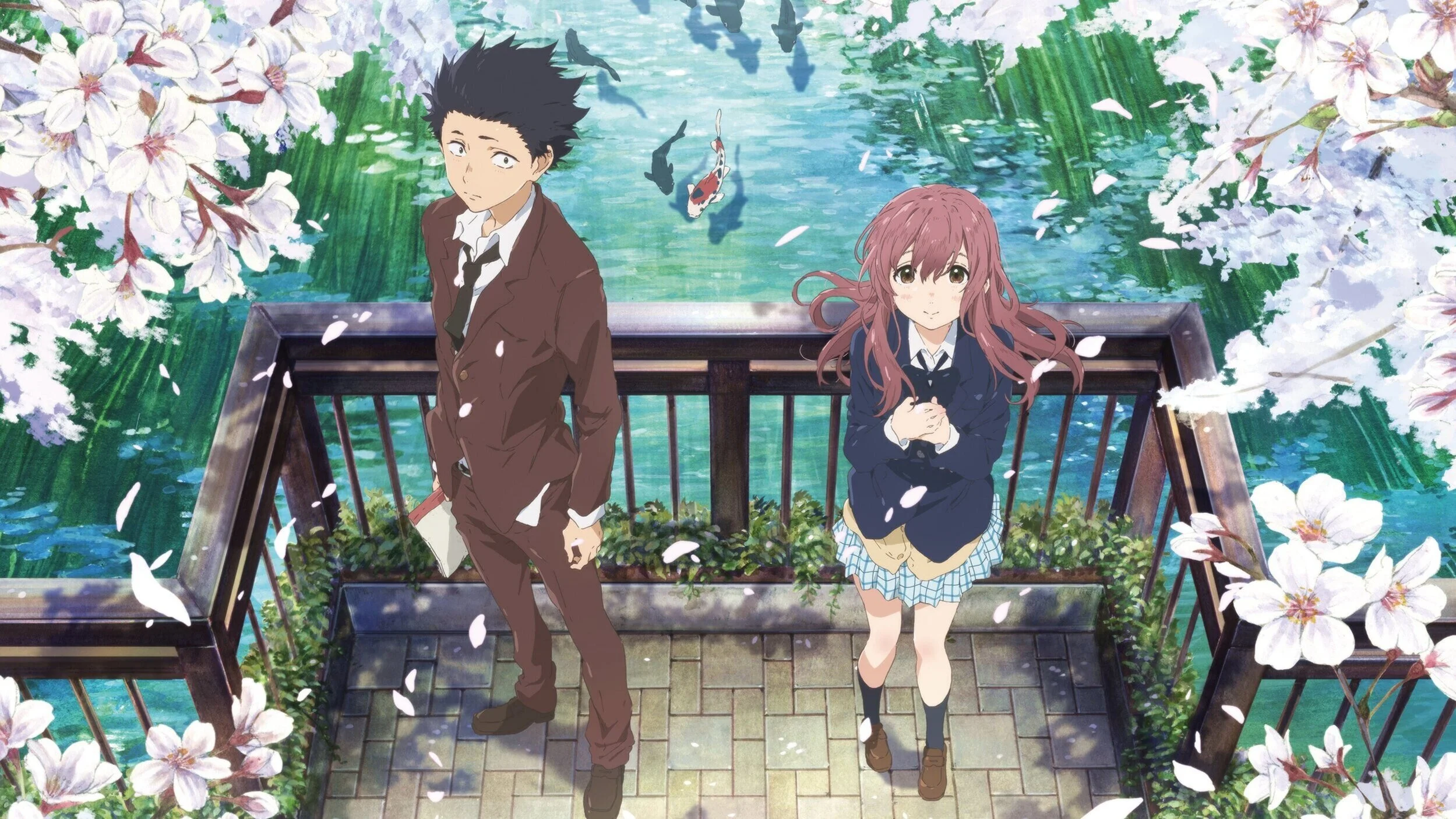
Not so long ago it seemed that a golden age in Japanese animation might be coming to an end, but then Your Name arrived out of the blue to bowl us over. That film was at heart a romance and I had hoped that Shinkai Makoto's work there might be equalled by what Yamada Naoko is now offering us here. If I was disappointed, my response may be linked to what is implied by the film's written title: A Silent Voice: The Movie. This suggests that Oima Yoshitoki's manga on which this film is based is very well known especially to Japanese audiences, and viewers who know what to expect will not be struggling to adjust as I was.
A Silent Voice begins with a potential suicide but then settles down instead into being a narrative about a schoolgirl, Nishimiya Shoko, whose hearing is impaired and who in consequence suffers from being bullied. Fellow student Ishida Shoya takes the lead in this by coming up with such ideas as stealing her hearing aids. Because of this Shoko is moved away to another school although the original school's total failure to help and protect her seems strange and unrealistic. However, the short-term outcome is that the other pupils now turn on Ishida himself and the long-term one is that the bully seeks to redeem himself. If he now hopes to offer friendship to Shoko (and the film does indeed put much stress on the nature of true friendship), it soon becomes evident that, despite what has happened at the outset, A Silent Voice is a love story about Shoko and Shoya.
Despite an opening blast of 'My Generation' by The Who, A Silent Voice is very Japanese in character and, not really being an animation for young children (its climax incorporates another scene of intended suicide), it is apt that the version on release here is subtitled. However, it is not easy to get on terms with the film because it has a large and sometimes confusing cast of characters not helped by the number of variations on a name that crop up in relation to a single person. The switches in tone also keep one at a distance as A Silent Voice moves between stark drama, humour and moments of sentimentality. Less distracting but also not helpful are a handful of subtitles that disappear before they can be read in full.
However, even when running for over two hours, A Silent Voice holds the interest and the animation has a distinctive mode including some odd stylisation when the faces of former friends now distanced from Ishida are portrayed symbolically with crosses that hide their features to suggest their disconnection. If those familiar with the manga may well be at ease with the film immediately, it is equally the case that my own response was heavily influenced by comparison with Your Name and the instant rapport that I felt with that film.
MANSEL STIMPSON
Voices of: Irino Miyu, Hayami Saori, Han Megumi, Toyonaga Toshiyuki, Ono Kensho, Yuki Aoi, Ishikawa Yui, Yuki Kaneko, Matsuoka Mayu.
Dir Yamada Naoko, Screenplay Yoshida Reiko, based on the books by Oima Yoshitoki, Ph Takao Kazuya, Art Dir Shinohara Mutsuo, Music Ushio Kensuke, Character Design Nishiya Futoshi.
Kyoto Animation-Anime Ltd/National Amusements.
129 mins. Japan. 2016. Rel: 17 March 2017. Cert. 12A.