

The first of two films reaching our screens centred on a remarkable octogenarian.
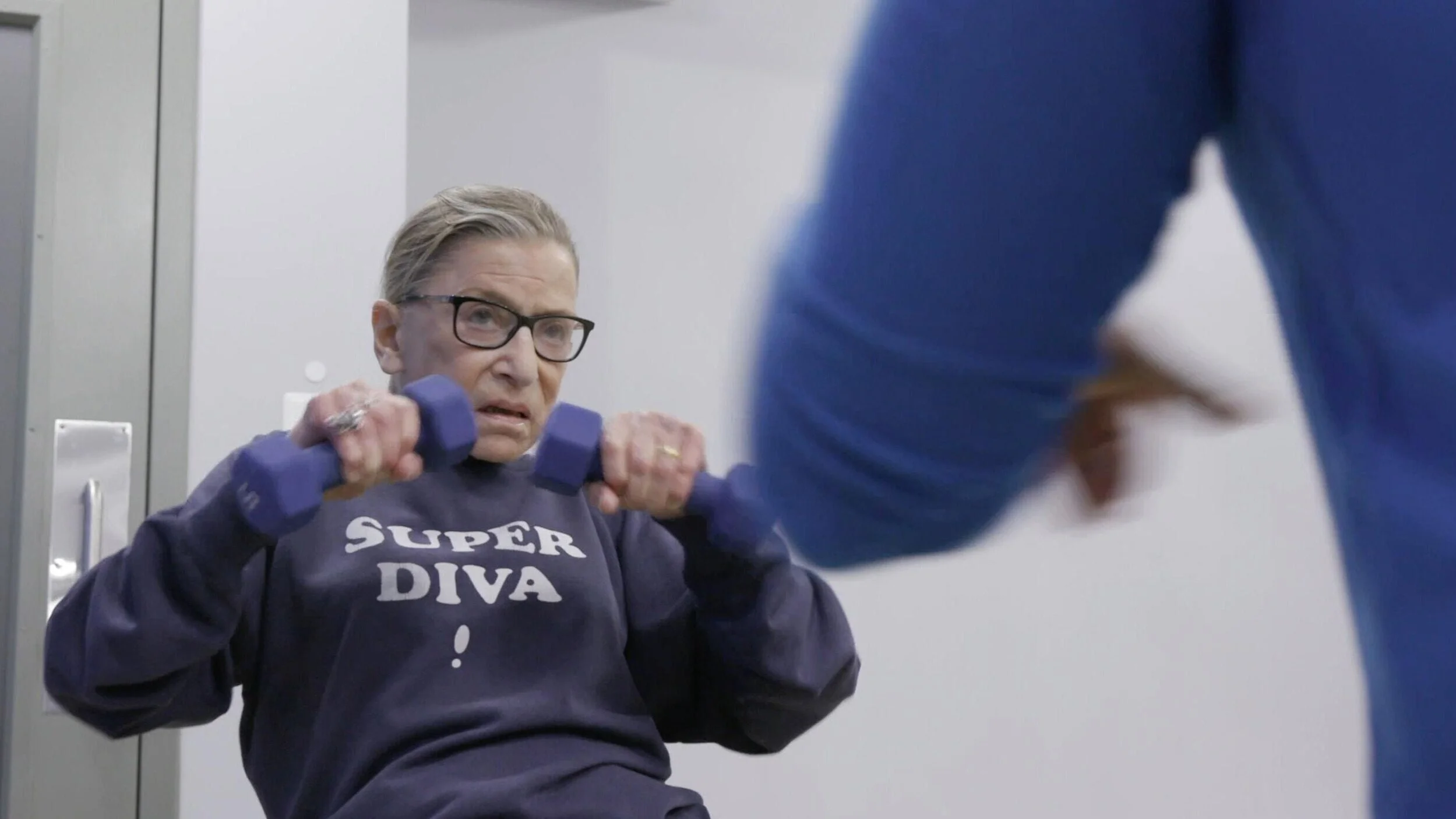
No dumbell: Ruth Bader Ginsburg
This documentary biopic takes the form of a well-earned tribute to Justice Ruth Bader Ginsburg who, in 1993, became only the second woman to be appointed to the American Supreme Court. Still in that post but now aged 85, Ginsburg has had a remarkable career and one that has enabled her to make a prime contribution to the cause of attaining equality for women and ensuring that their legal rights are not less than those of men. Her long life (she was born in Brooklyn in March 1933) means that she herself encountered inequality when seeking a legal post after graduating from Columbia Law School, but in time she established herself as a counsel drawn to cases in which the law as it then stood discriminated unfairly. Not all of the discrimination she challenged had a sexual basis yet it is not too much of an exaggeration to say that she changed the world for American women.
RBG, made by Betsy West and Julie Cohen, is an account of Ginsburg's life and career that proceeds chronologically for the most part. However, it does make early use of archive material showing her 1993 address when seeking confirmation of her appointment to the Supreme Court and it also utilises fresh footage of her as she looks back on her life. Many court cases are touched on, but her personal life is not ignored including the vital contribution made by her husband, Martin, whom she met when just seventeen and who would himself become a professor of law. Despite Ruth's impact in court she was usually quiet, soft-voiced and shy in person while Martin, who died of cancer in 2010, was outgoing and socially inclined, thus making them a contrasted couple who, as it turned out, complemented one another perfectly.
Later this year Ginsburg's story will be again be seen on our screens in On the Basis of Sex. Because that work is a dramatisation using actors, it may well prove to have the wider appeal, but it concentrates on her early career and in any case, RBG is the more compelling piece. The fact that both movies are appearing now is doubtless linked to the fact that in Trump's America Ginsburg is increasingly seen as an icon relevant to the young as well as to older generations, a figure admired not just for her feminist views (Gloria Steinem is just one of many contributors seen here) but as a standard-bearer for liberal values. Towards the end West and Cohen do allow their film to meander somewhat when to be tighter would be better (as part of the personal portrait it is apt to incorporate references to Ginsburg's love of opera but the timing is out when at the very moment when the film should be winding up it indulges in footage of her on stage in 2016 in a spoken role in Donizetti's La fille du régiment). But no matter: this is a hugely sympathetic work, a close look at a woman who deserves all the attention she is getting and, in passing, a rather remarkable love story too.
MANSEL STIMPSON
Featuring Ruth Bader Ginsburg, Gloria Steinem, Bill Clinton, Arthur R.Miller, Jane C. Ginsburg, James Steven Ginsburg, Sharron Fiontiero, Ossin Hatch, Lily Ledbetter, Nina Totenberg, Stepen Wiesenfeld.
Dir Betsy West and Julie Cohen, Pro Julie Cohen and Betsy West, Ph Claudia Raschke, Ed Carla Gutierrez, Music Miriam Cutler.
Magnolia Pictures/Participant Media/CNN Films/Storyville Films/Better Than Fiction Productions-Dogwoof.
98 mins. USA. 2018. Rel: 4 January 2019. Cert. PG.